Español.-
Un grupo de colonos israelíes abrió fuego hacia un grupo de agricultores y granjeros palestinos mientras estaban laborando sus tierras cerca de la villa de Deir Istiah, en Salfit, al norte de Cisjordania, según reporte de Palestine News Network.
La autoridad principal de la ciudad, Nazmi Salam, dijo que los granjeros fueron sorprendidos por unos cuantos colonos que se acercaron a caballo disparando armas de fuego. Los campesinos huyeron corriendo para no ser alcanzados por las balas.
Testigos reportaron que los trabajadores palestinos se encontraban fertilizando las plantaciones de olivo, preparando la producción que será cosechada en octubre, cuando fueron sorprendidos por los disparos de los colonos. Los mismos testigos aseguraron haber visto que los atacantes provenían del asentamiento ilegal Emmanuel y agregaron que es común que los colonos ataquen a los trabajadores rurales, los amenacen y hagan lo imposible para interrumpir la cosecha anual de olivos.
English.-
A group of Israeli settlers opened fire at a group of Palestinian farmers while working on their lands near the village of Deir Istiah, near Salfit In the northern West Bank, Palestine News Network reported.
The head of the village council Nazmi Salman said the three farmers were surprised to see around ten settlers coming towards them on horses and shooting at random. The three farmers had to flee in order not to be hurt.
Witnesses reported that the farmers were fertilizing their olive orchard in preparation for the harvest season in October when the settlers attacked them. The witnesses said that the settlers came from the nearby settlement of Emmanuel, adding that settlers from many other settlements threaten the farmers and try to interrupt the olive harvest season every year.
martes, 31 de agosto de 2010

Barrio de Jersualén oriental atacado por soldados israelíes-East Jerusalem neighborhood attacked by Israeli soldiers

Español.-
El barrio de Silwan, que ha sido marcado por Israel para ser desalojado de residentes palestinos, se mantuvo bajo fuego en la noche de ayer lunes cuando fuerzas militares de Israel lo invadieron aduciendo que algunos palestinos del barrio habían provocado enfrentamientos con colonoes el pasado jueves.
En los enfrentamientos ocurridos el pasado jueves, un grupo de colonos, intentaron entrar con prepotencia en la mezquita Al Ein Mosque, del barrio de Silwan, pero los residentes locales lograron bloquearles el paso. Los colonos de Israel han asaltado violentamente varias veces el barrio de Silwan en los últimos meses, han tomado y destrozado hogares y negocios por la fuerza y golpeado a sus ocupantes.
De acuerdo a las fuentes locales, las tropas invadieron el barrio, ayer lunes, por la mañana, focalizando el ataque a las áreas de Wad Hilwa y Al Bustan. Allí detuvieron secuestrados a los hermanos Su'ad y Jawad Abu Rumouz de Al Bustan, también a los hermanos Fadi y Nur Siyam de Wad Hilwa, y al muezzin de la mezquita Al Ein, Adam Simrin de 68 años de edad.
Fadi y el hermano menos de otro joven llamado Nur's de 16 años, fueron citados a la estación de policía de Israel para prestar declaración y ser interrogados hoy martes a la mañana.
Las fuerzas israelíes invaden con frecuencia Silwan, que se ha convertido en un sitio clave en la lucha contra las demoliciones de hogares palestinos y los desalojos. La municipalidad de Israel, reveló el año pasado su intención de vaciar de residentes palestinos el barrio para establecer un para tematico, biblíco, para turistas.
English.-
The Silwan neighborhood, which has been the site of an Israeli municipal plan to rid the neighborhood of its Palestinian residents, came under fire once again on Monday when Israeli forces invaded to abduct Palestinians that they claim took part in clashes with settlers last Thursday.
In Thursday's clashes, a group of Israeli settlers attempted to enter the Al-Ein Mosque in the Silwan neighborhood, but locals tried to block them from entering the mosque. Israeli settlers have violently assaulted Palestinians in Silwan in recent months, and have taken over homes and businesses, kicking out the original owners.
According to local sources, Israeli troops invaded the neighborhood Monday morning, focusing on the Wad Hilwa and Al Bustan areas of the neighborhood. They abducted a brother and sister Su'ad and Jawad Abu Rumouz from Al Bustan, two brothers Fadi and Nur Siyam from Wad Hilwa, and the muezzin (prayer caller) of the Al-Ein Mosque, Adam Simrin, age 68.
Fadi and Nur's younger brother Hamza, 16, received a summons to come to the Israeli police station on Tuesday morning for questioning.
Israeli forces frequently invade the Silwan neighborhood, which has become a flashpoint in the Palestinian struggle against home demolitions and evictions. The Israeli municipality of Jerusalem last year revealed a plan to rid the neighborhood of its residents in order to establish a Biblical theme park for tourists on the site.
Fuerzas de Israel invaden Rafah; registran enfrentamientos-Israeli forces invade Rafah; clashes reported

Español.-
El pasado domingo, tanques israelíes, bulldozers y vehículos armados invadieron el sur de la Franja de Gaza, al este de Rafah, y comenzaron a avanzar removiendo la tierra en el barrio de An-Nahda.
Un vocero de las brigadas Al Aqsa, dijo que intercambiaron disparos con las fuerzas israelíes, para obligarlos a retirarse hacia la frontera donde tienen situada una base.
El ejército israelí no confirmó el incidente pero sí reportó que les había caído un mortero el lunes temprano en la mañana, proveniente de la Franja de Gaza, dirigido hacia campo abierto ocupado por Israel.
Las invasiones de Israel son comunes en Gaza, a pesar de haberse desligado, Israel de Gaza, desde 2005. Rafah es el objetivo frecuente de las invasiones y se han registrado miles de demoliciones de hogares, producto de que Israel quiere crear otra zona de seguridad entre la ciudad y sus límites.
English.-
Late Sunday night, Israeli tanks, bulldozers and armored vehicles invaded the southern Gaza Strip, east of Rafah, and began bulldozing land in the An-Nahda neighborhood.
A spokesperson for the Al-Aqsa Brigades, said its fighters exchanged fire with the invading Israeli soldiers, leading the troops to retreat back to their base on the southern Gaza border.
The Israeli military did not confirm the incident, but did report that one mortar shell was fired Monday morning from the Gaza Strip into an open field in southern Israel.
Israeli invasions of Gaza are common, despite the Israeli disengagement from the Gaza Strip in 2005. Rafah is a frequent target of invasions, and has seen thousands of home demolitions by Israeli forces attempting to create a 'security zone' between the city and the border.
Artistas israelíes se suman a boicot de centro cultural Ariel-Israeli artists boycott new Cultural Center in Ariel settlement

Español.-
Medio centenar de actores y profesionales del teatro israelí se han negado a actuar en una colonia judía en territorio palestino, reabriendo el debate sobre la legitimidad del boicot interno a la política de ocupación.
El anuncio la pasada semana de que las principales compañías de teatro nacionales harán representaciones en el nuevo centro cultural del asentamiento de Ariel, en el norte de Cisjordania, fue seguido casi de inmediato por la declaración de varios actores de que no actuarían allí por motivos ideológicos.
"Los colonos y los asentamientos no es algo que me divierta y yo no quiero divertirles a ellos", declaró Yusef Sweid, miembro del plantel de una obra que se representa en el Teatro Nacional Habima de Tel Aviv.
A las primeras negativas se sumaron otras y ya son 53 los directores, guionistas y cómicos que han firmado un texto rechazando trabajar en la colonia, lo que ha generado un conflicto a sus compañías, que habían comprometido representaciones en la nueva sala, y han llevado al jefe del Gobierno, Benjamín Netanyahu, a amenazar con retirar la financiación a los teatros con actores díscolos.
El centro cultural de Ariel, con capacidad para 540 personas y que tiene previsto inaugurarse el próximo 8 de noviembre, ya ha comenzado a vender entradas y anunciado un programa con ocho representaciones de las compañías del Habima y el HaCameri, en Tel Aviv; el Teatro de Beer Sheva y el Jan de Jerusalén.
El Gobierno israelí ha tratado de atajar el incipiente boicot con una tajante declaración por parte de la ministra de Cultura y Deporte, Limor Livnat, que acusó a los opositores de "dividir a la sociedad israelí", pidió separar política y arte, y aseguró que "todo israelí tiene derecho a disfrutar de la cultura en cualquier lugar".
Los firmantes de la misiva, entre ellos varias estrellas como el director, guionista y escritor Yehoshua Sobol o el actor Yossi Pollak, no cuestionan el derecho de los colonos a disfrutar del teatro, pero defienden su derecho a oponerse a la colonización.
Otros artistas, como Gila Almagor, ganadora del Premio Israel de teatro, no han refrendado la misiva pero aseguran que, igualmente, no actuarán en los asentamientos en territorio palestino.
"Siempre me he opuesto a la ocupación y me he negado a actuar más allá de la línea verde (divisoria establecida tras el alto el fuego de la guerra de 1948). No iré a lugares opuestos a mi visión del mundo", declaró al diario "Haaretz" la veterana actriz, que agregó que "no pediría a los actores religiosos que trabajasen en la jornada del shabat", día semanal sagrado en el judaísmo.
El boicot ha sido esta mañana objeto de debate en el consejo de ministros y ha levantado ampollas entre los miembros del Gabinete.
Netanyahu ha amenazado con retirar la financiación a los teatros cuyo personal boicotee el centro de Ariel y ha señalado que, al ser Israel "objeto de un ataque de deslegitimación por parte de distintos elementos en la esfera internacional (...) lo último que necesita es un intento de boicot desde dentro".
El ministro de Finanzas, Yuval Steinitz, dijo que "Ariel es una comunidad en Israel" como cualquier otra y pidió que se despida a los que incumplan sus contratos y no actúen allí.
Lo mismo exigen los representantes de los colonos, que aseguran que los rebeldes "deben ser despedidos de inmediato porque sus compañías son financiadas con impuestos que también pagan los ciudadanos de Judea y Samaria (nombres bíblicos para Cisjordania)", dijo a Efe Aliza Herbst, portavoz del Consejo colono (Yesha).
Los intérpretes, añadió, "tienen que dedicarse a actuar y mantenerse lejos de la política, porque ni tienen formación para ello, ni son personajes políticos, ni tienen dotes analíticas brillantes. Ése no es su campo, sino el de la actuación y a eso se tienen que limitar, no a fomentar sanciones culturales contra una parte de la población".
El consejo de asentamientos ha instado al público israelí a cancelar sus suscripciones a los teatros y boicotear las obras en que trabajen quienes se niegan a actuar en Ariel.
En el lado contrario se encuentra el periodista israelí Gideon Levy, quien señalaba hoy en "Haaretz" que el debate demostrará si en su país hay "un teatro genuino o simplemente un teatro de marionetas".
"Hay una diferencia moral entre el Israel soberano y legítimo y las áreas bajo su ocupación. Entre actuar aquí o allí, en el corazón de un asentamiento ilegal, construido en una tierra robada, en una representación diseñada para ayudar a los colonos a pasar un tiempo agradable, mientras están rodeados de personas a las que se ha despojado de todos sus derechos"
English.-
Dozens of prominent artists in the Israeli theatre community – including actors, playwrights and directors -- have signed a pledge that they will not perform in a newly-constructed cultural center in the Israeli settlement of Ariel. The pledge could cause the artists to be booted from the government-funded guild for theatre professionals, but they argue that this act of conscience is more important than their salaries.
Signatories include some of Israel's most prominent actors like Yousef Sweid and Rami Heuberger, as well as playwright Joseph Sobol, famous for a play he wrote about the Holocaust called 'Ghetto'. Some of those who signed the boycott pledge say that it is ironic that the new cultural center in Ariel settlement will be inaugurated with performances of the plays of Bertolt Brecht, who stood for justice for the oppressed – they say he would be turning in his grave if he knew his plays were being used as a tool of political oppression.
While the Israeli Culture and Sport Minister Limor Livnat argued that there is no difference between performing inside Green-line (1967 armistice borders) Israel and settlements, saying, “I call for the scheduled performances to be carried out as scheduled in Ariel and all over the country, as each citizen has the right to consume culture anywhere he chooses”, others disagree with the Minister, saying that performing in settlements constructed across the Green Line in violation of international law constitutes an inherently political act.
Analyst Gideon Levy wrote in his column in Ha'aretz, “At a time when the Tate Modern in London is presenting the impressive video work of Francis Alys, an artist who walked with a bucket of paint to draw the Green Line anew, Israel is doing its utmost to blur it. Now theater has mobilized on behalf of this campaign of obfuscation and darkness. Yes, there is a difference between legitimate, sovereign Israel and the areas of its occupation. Yes, there is a moral difference between appearing here and appearing there, in the heart of an illegal settlement (illegal, like all of its settlement siblings ) built on a plot of stolen land, in a performance designed to help settlers pass their time pleasantly, while surrounded by people who have been deprived of all their rights.”
The Yesha Council of Settlements responded to the boycott with a statement saying, “Our response to the letter signed by the army evaders and anti-Zionist left-wing activists will be very harsh.” They called on the theatre managers to fire all of those who signed the petition. The mayor of Ariel settlement told reporters that the artists in question cannot both receive government salaries and have a conscience.
Analyst Gideon Levy responded with, “Theater is not an army, actors are not soldiers, and artists who boycott performances are not draft dodgers. The few dozen theater figures who have signed the statement saying they will boycott Ariel are people of conscience who deserve praise. Should more be added to this list, the show won't go on at Ariel.”
jueves, 26 de agosto de 2010
Gideon Levy: "El periodismo es el máyor coolaborador de la ocupación israelí"-"The media is the biggest collaborator with occupation in Israel

Español.-
Gideon Levy: El perdiodismo es el mayor colaborador con la ocupación isarelí.
La semana pasada MAP (Medical Assitance for Palestinians) estuvo presente en un encuentro con el reportero y editor del diario israelí Ha'aretz, Gideon Levy, en Londres.
Levy habló sobre el "proceso de deshumanización y demonización" de los palestinos en los medios israelíes, quienes a pesar de considerarse "profesionales y libres", eligen cerrar los ojos y hacer caso omiso a la ocupación ilegal.
Particularmente esto se cumple de tal manera cuando se refieren a la situación en Gaza. A los reporteros isarelíes se les prohibió la entrada en Gaza desde noviembre de 2006. Mr Levy describe cómo por ejemplo, durante la operación "plomo fundido", la muerte de dos perros de isarelíes fue puesta en primera plana mientras que la cobertura de cientos de palestinos muertos fue confinada a las últimas páginas de los periódicos.
Él caracteriza a Israel como "un estado de apartheid pero sin nigún criterio" y agrega que las chances de que el cambio surja desde la sociedad israelí "son nulas", porque la gente, dice, "está en coma" respecto de la ocupación ilegal.
Respecto de las actuales conversaciones depaz, Levy opina que "son una máscara porque la gente de Israel demuestra aparentemente querer negociar por siempre y para siempre, y el peligro es que el fracaso en estas conversaciones puede conducir a una fase más violenta."
English.-
Gideon Levy: The Media in Israel is the biggest collaborator with the Occupation
This week MAP attended a CAABU organised meeting with Ha’aretz journalist and editor Gideon Levy in London.
Mr Levy spoke of the “ongoing process of dehumanization and demonizing” of the Palestinians in the Israeli media, which despite being “professional and free” chooses to turn a blind eye to the occupation.
This is particularly true when it comes to reporting on the situation in Gaza. Israeli journalists have been banned from entering Gaza since November 2006. Mr Levy described how during Operation: Cast Lead the deaths of two Israeli dogs received front page coverage whilst news of hundreds of Palestinian casualties was confined to the back pages.
He described Israel as “an Apartheid state by any criteria” and spoke of how the chances of change coming from within Israeli society “are zero’ as people are ‘in a coma’ towards the Occupation.
In response to the news of upcoming peace talks, Mr Levy described them as an “ongoing masquerade” as “the absence of leadership in Israel means that people are happy to negotiate forever, the danger is that the failure of the talks might initiate a more violent phase”.
martes, 24 de agosto de 2010
Cerca de Nablus, colonos incendian campos agrícolas palestinos-Near Nablus settlers fire Palestinian farmlands


Español.-
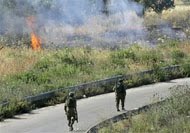
Un grupo de colonos extremistas de Israel, inecndió el domingo, 20 dunams, cerca de 5 acres de tierras agrícolas palestinas al sur de Cisjordania cerca de la ciudad de Nablus.
Los colonos llegaron desde el asentamiento ilegal de Ihya y prendieron fuego en las tierras de Khallet Abu Shreka, cerca de la villa de Jalud y una vez encendidas y dispersadas las llamas huyeron del lugar.
El ataque es uno más de los ataques comunes de los colonos que pretender extender el área ocupada para construir más asentamientos.
El ataque fue seguido inmediatamente, por una invasión militar israelí a la villa donde los soldados amedrentaron a los residentes con granadas de estruendo y gases lacrimógenos.
English.-
A group of extremist Israeli settlers torched, on Sunday, 20 Dunams (nearly 5 acres) of Palestinian farmlands south of the northern West Bank city of Nablus.
The settlers came from the Ihya illegal settlement outpost and torched farmlands in Khallet Abu Shreka, near Jalud village and left the scene later on.
The attack is one of numerous attacks carried out by the settlers who seek to expand their outpost and to construct new illegal outposts on Palestinian lands.
The recent attack was followed by an Israeli military invasion to the village as the soldiers also fired tear gas canisters at the local residents
Soldados israelíes secuestran a 12 palestinos-Desmantelan plantación en Gaza-Israeli soldiers kidnap 12 Palestinians-Uprooted in Gaza


Español.-
Soldados de israel secuestraron, ayer lunes al amanecer, a 12 ciudadanos palestinos en diferentes áreas de la ocupada Cisjordania y los traslador a campos de concetración, llamados "centros de interrogatorio".
Mientras tanto en Gaza, máquinas retroexcavadoras del ejército desmantelaron plantaciones.
El ejército pretende aclarar que los detenidos son "buscados" pero no revelan si son miembros de grupos peligrosos o facciones violentas de resistencia o de qué se los acusa en realidad.
Los secuestros de palestinos son parte de una campaña diaria llevada a cabo contra los residentes de Cisjordania, incluyendo las áreas que están controladas -o deberían- por la Autoridad Palestina del Presidente Mahmoud Abbas.
En noticias por el estilo, un grupo de soldados invadió también el lunes por la maána el área de Rafah en el sur de la Franja de Gaza.
Allí, el ejército acompañado de tanques militares y máquinas retroexcavadoras, ingresó más de 300 metros en tierras afrícolas de granjeros del lugar en el pueblo de Al Nahda, al este de Rafah, desmantelaron los cultivos y luego incendiaron los alrededores.
English.-
Israeli soldiers kidnapped, on Monday at dawn, 12 Palestinians in different areas of the occupied West Bank, and transferred them to a number of interrogation centers. In Gaza, army bulldozers uprooted farmlands.
The army claims that the kidnapped residents are “wanted” but did not reveal whether they are members of certain Palestinian groups of resistance factions.
The kidnapping is part of a daily campaign carried out by the Israeli army against Palestinians living in the occupied West Bank, including areas that are “controlled” by the Palestinian Authority and the security forces of president Mahmoud Abbas.
In related news, Israeli soldiers invaded, on Monday at dawn, an area east of Rafah city in the southern part of the Gaza Strip.
The army, accompanied by a number of tanks and military bulldozers, advanced 300 meters into farmlands located in al-Nahda area, east of Rafah, and bulldozed farmlands while firing at random, local sources reported.
Suscribirse a:
Comentarios (Atom)