martes, 30 de noviembre de 2010

Israel demuele poblado beduino de Abul Al Ajaj-Israel demolish bedouin village, Abul Al Ajaj


Video: http://www.youtube.com/watch?v=-Q1l92aqw-Y

Español.-
La semana pasada, los habitantes beduinos palestinos de Abu Al Ajaj, vieron a medida que el sol amanecía cómo, máquinas retroexcavadoras, bulldozers, de Israel, arrasaban su pequeño poblado sobre el Valle del Jordán, dando por tierra con todo lo que poseían inclusive los corrales de su ganado, los gallineros y los nidos.
Esto ocurrió tan sólo horas después de que autoridades de Israel notificaran a estos pobladores beduinos que esas tierran habían sido confiscadas para expandir un asentamiento ilegal.
Un corresponsal de la agencia noticiosa Ma'an visitó el lugar en donde lo 135 miembros pertenecen a la familia D'eis. Uno de los testigos le contó cómo las máquinas arrasaron con las barracas, corrales, gallineros, tanques de provisión de agua para uso doméstico y para el ganado. El agua, bien preciado para estas poblaciones fue derramada por el suelo. La gente del lugar contó que en pocas horas habían tirado abajo toda la villa.
Los lugareños manifestaron al reportero que aquellos que quisieron interponerse para defender su propiedad fueron agredidos violentamente por los soldados. Entre las personas que sufrieron consecuencias físicas de esta agresión, uno de los afectados es un señor ya anciano identificado como Shihda D'eis. Los soldados detuvieron a gran cantidad de palestinos. Algunos fueron liberados y otros, tal como Osama Omar D'eis y Ali Shihda D'eis permanecen en prisión, sin cargos.
Luego de la demolición, vehículos militares se estacionaron en la entrada de la villa y más tarde se acercaron al lugar activistas internacionales y personal de la Cruz Roja.
Abu Al-Ajaj es una pequeña villa en el área de Jiftlik que es la segunda más poblada en el Valle del Jordán, después de Jericó. Alrededor de 7000 granjeros palestinos viven en Jiftlik y se sustentan de la agricultura.
La representante de la campaña "Save the Jordan Valley" (Salvemos al Valle del Jordán), describió el ataque sobre Abu Al Ajaj, como una acción de limpieza étnica llevada a cabo sin tapujos, frente a los ojos del mundo y las instituciones internacionales de derechs humanos.

English.-
As the sun rose early, last week, Palestinian Bedouins living in Abu Al-Ajaj, a small village in the Jordan Valley, were surprised to see Israeli bulldozers demolishing their sheds and sheep shelters.
The incident came only several hours after Israeli authorities confiscated lands belonging to the village slated to expand an illegal settlement.
Ma'an's correspondent visited the village whose 135 residents are all members of the D'eis family. He said he saw demolished sheds and barracks as well as water tankers which provide water for domestic use and for animals to drink. The water was spilt on the ground. Locals told him that bulldozers completed the demolition in the early morning.
He was also told that Israeli soldiers who escorted the bulldozers attacked residents when they attempted to defend their property. Amongst those beaten by the soldiers was an elderly man identified as Shihda D'eis. The soldiers detained several people and released some of them later. Osama Omar D'eis and Ali Shihda D'eis remained in detention, according to locals.
After the demolition, military vehicles were stationed at the entrance to the village and later on Red Cross staff and international solidarity activists from the International Council of Churches arrived in the village.
Abu Al-Ajaj is a small village in the Jiftlik area which is the second largest populated area in the Jordan Valley after Jericho. About 7,000 Palestinian farmers live in Jiftlik and earn their living from agriculture and livestock.
The "Save the Jordan Valley" campaign described the attack on Abu Al-Ajaj village as "ethnic cleansing practiced before the very eyes of the whole world and international human rights institutions."

jueves, 25 de noviembre de 2010

Soldados de Israel demuelen mezquita en Tubas-Israeli soldiers demolish mosque in Tubas


Español.-
Fuerzas militares de Israel destruyeron hoy una mezquita en el barrio de Yazra, poblado de Tubas, en la ocupada Cisjordania, según reportaron fuentes palestinas.
Efectivos israelíes irrumpieron a primera hora de este jueves en la pequeña localidad de Tubas y provocaron reacciones airadas de los residentes musulmanes al derribar una mezquita, lo que calificaron de violación de los derechos esenciales del pueblo palestino.
Ahmad As'ad, oficial palestino, manifestó que los soldados invadieron el área, que dijeron que es un área militar cerrada y que ahí será un campo de entrenamiento militar israelí demoliendo la mezquita. Esta mezquita había sido construida mucho antes de 1967 cuando fueron invadidos por Israel y ocupados por la fuerza los territorios palestinos de Cisjordania. Los pobladores de Yazra habían agregado dos habitaciones a la mezquita y todo fue arrasado.
Ahmad As'ad agregó que los residentes tienen un documento oficial que prueba que tenían licencia para la construcción tanto de la mezquita como de los dos cuartos aledaños.
Las tropas echaron por la fuerza a los pobladores palestinos y dijeron que seguían órdenes estrictamente militares.
El vecindario de Yazra se encuentra al este de Tubas, son unos 200 vecinos los que habitan allí. Su sustento depende mayormente de la agricultura.
Tubas es uan ciudad pequeña al noreste de Cisjordania, a 21 kilómetros de Nablus y a pocos kilómetros del Valle del Jordán.
El atropello ocurrió un día después de que bulldózers y carros del Ejército sionista conducidos por soldados arrasaron la aldea beduina palestina de Um Al-Ajaj, en el valle del río Jordán, destruyendo tiendas, precarias viviendas y mataron una veintena de ovejas.
Durante el derribo de las casas y barracas, los militares agredieron a los beduinos que trataron de defender sus propiedades, y arrestaron a una decena de personas.
Según denuncias de grupos de derechos humanos, las tropas sionistas también demolieron este miércoles al menos siete estructuras de mampostería levantadas por los palestinos en la zona oriental de la Ribera Occidental.

English.-
Palestinian News Agency, Ma'an, reported on Thursday that Israeli bulldozers leveled a mosque in the neighborhood of Yazra in the eastern part of the central West Bank city of Tubas. The army claimed that the mosque was built without a construction permit.
Ahmad As'ad, a Palestinian official, stated that soldiers invaded an area regarded by the army as a military training field, and they declared it a closed military zone before demolishing the only mosque which. The mosque was built in 1967 and the residents have attached two extra rooms to it .
As'ad added that the residents have official papers that prove the licensed construction of the mosque in 1967, and that the two rooms were added due to the increasing number of residents who attend this mosque.
Also, the troops tried to push the residents out of the area by imposing tight measures and strict military orders.
The neighborhood of Yazra is located in the eastern part of Tubas, with a population of nearly 200 people. All heavily depend on agriculture and livestock as the main source of livelihood.
Tubas is a small Palestinian city in the northeastern West Bank, located only 21 kilometers (13 mi) northeast of Nablus, a few kilometers west of the Jordan River

lunes, 22 de noviembre de 2010

Un refugiado de 100 años recibe un nuevo hogar-100-year-old refugee gets new Gaza home


Rami Almeghari writing from occupied Gaza Strip, Live from Palestine.
All photos by Rami Almeghari.
Rami Almeghari is a journalist and university lecturer based in the Gaza Strip

Español.-
Los cuatro miembros de la familia Abu Daher vivieron el día más feliz de su vida desde que excavadoras del ejército israelí aplastaran su casa de cemento hace casi dos años durante el asalto masivo de Israel sobre la Franja de Gaza.
"Este es un día memorable para mí, mi anciana madre, mi hermano discapacitado y mi hermana", dijo Suhaila Abu Daher, mentras estaba sentado por primera vez en una nueva construcción, una casa 60 metros cuadrados cerca del barrio Izbet Abed Rabbo de refugiados de Jabaliya, campamento en el norte de Gaza. La nueva casa se encuentra a poca distancia de la tienda en la que la familia había vivido desde el ataque israelí que dejó a muchísimas otras familias de Gaza, sin hogar.
"En primer lugar, gracias a Dios, y luego a todos los que nos ayudaron a tener una casa para protegerme a mí y a mi familia del calor, el frío y tantas otras cosas terribles, como las serpientes y los perros y gatos callejeros", dijo Abu Daher, flanqueado por su madre de 100 años de edad, conocida como Umm Ahmed, sentada en una silla de ruedas, y su hermano Mohamed, que ha vivido con discapacidad severa desde su nacimiento.
Abu Daher vertió elogios sobre la Rahma (misericordia) Sociedad de Kuwait, el Ministerio de Vivienda en Gaza y el "hombre benévolo que donó el terreno para esta nueva casa."
"Que Dios los bendiga a todos en estos días benditos, antes del Eid al-Adha", dijo, refiriéndose a la fiesta musulmana que marca el final de la peregrinación anual a La Meca.
"Durante el invierno, no he podido bañar a mi madre a veces durante dos semanas, debido al frío intenso dentro de la tienda", recuerda Abu Daher. "En verano solíamos tener serpientes y animales callejeros que se metían dentro de la carpa. Era asqueroso, pero gracias a Dios por fin estamos en una casa normal". La nueva casa es pequeña, pero ofrece a la familia una cocina y un baño.
Un alegre Ahmad Umm levantó las manos al cielo y pronunció las bendiciones del Eid para todos aquellos que habían ayudado a la familia.
"Mi hijo, lo que hemos pasado antes de hoy, han sido los peores días de mi vida", dijo Umm Ahmad con voz temblorosa. "Cuando yo era joven en Beer al-Sabe teníamos la libertad de vivir tranquilos en nuestra propia tierra y en nuestros propios hogares. Recuerdo que solíamos vivir felices, que intercambábamos nuestros cultivos por ganado. Desde que fuimos desplazados por Israel tantos como yo, hemos perdido todo. Sin embargo, Dios es grande y siempre es misericordioso con nosotros. "
Beer al-Sabe, la ciudad natal de Um Ahmad fue limpiada étnicamente, hoy se conoce por los israelíes, que la ocuparon en 1948, como Beersheva.
Umm Muhammad Ahmad, el hijo expresó su satisfacción y recordó los días terribles durante el ataque israelí: "Créame, el ejército ni siquiera nos permitía hincarnos para orar, así que no oré durante muchos días en los que el ejército nos atacaba y nos cercaba."
La entrega de la nueva casa de la familia Abu Daher es parte de un proyecto financiado por Rahma Kuwait Society, una organización que ofrece servicios globales de socorro, y el Ministerio de Vivienda en Gaza.
Según datos oficiales, hay alrededor de 3.500 familias que se quedaron sin hogar durante los ataques de Israel a largo de enero de 2009. Fuentes del Ministerio de Vivienda, que es controlada por el movimiento Hamás, dicen que la mayoría de los desplazados viven en viviendas de alquiler, mientras que otros permanecen en campamentos.
Desde el ataque, prácticamente sin materiales de construcción, ya que no han sido admitidos por el estado de sitio agobiante israelí, que se ha mantenido en su lugar de Gaza desde junio de 2007. A pesar de las promesas internacionales de ayuda a la reconstrucción por un total de $ 4,000,000,000 que se hizo en una conferencia de donantes, en marzo de 2009, poco se ha entregado.
Tras el atentado perpetrado contra Israel a la Flotilla de la Libertad de Gaza en mayo pasado, Israel anunció una "flexibilización" del sitio, permitiendo que algunos bienes de consumo a Gaza, pero aún así la prohibición de materiales de construcción.
"Esta casa es la primera que se termina de construir en Gaza" dijo Kamal Misleh, director de la Sociedad Rahma. "Hemos reconstruido otras 700 viviendas parcialmente destruidas en Gaza y esperamos continuar con el plan para completar la construcción de 100 casas para otras familias" El proyecto es apoyado por el Banco Islámico de Desarrollo, dijo Misleh.
Acerca de cómo será la forma de llevar a cabo el proyecto de recosntrucción ante la falta total de materiales, Misleh explicó a The Electronic Intifada: "Es cierto que no hay materiales de construcción procedentes del exterior de Gaza a causa del bloqueo, pero hemos encontrado estos materiales en el mercado local. Tal vez se pasan de contrabando a través de túneles subterráneos en la frontera entre Egipto y Gaza."
Sin embargo, estos materiales tienen un alto costo. Según Misleh, la conjstrucción de la pequeña casa de Abu Daher, tuvo un costo de $ 25.000. "Estamos felices de poder ayudar a esta familia y seremos más felices de extender la ayuda a otras familias similares en un futuro próximo, si Dios quiere", dijo Misleh.
Yousef al-Mansi, Ministro de Vivienda y Construcción, fue el encargado de acompañar a la familia de Abu Daher a tomar posición de su nuevo hogar. Le dijo a The Electronic Intifada, "Nos gustaría pedir a la opinión pública mundial que preste atención a la cantidad de familias desplazadas en Gaza. Por favor, despierten, hay todo un pueblo estrangulado por el asedio, en los que al menos un miembro del Cuarteto de Naciones Unidas, está involucrado."
Desde que Hamas ganó las elecciones palestinas en 2006, el Cuarteto, integrado por los Estados Unidos, el Secretario General de las Naciones Unidas, la Unión Europea y Rusia, han boicoteado a Hamas al tiempo que imponen condiciones previas de las que Isarel por supuesto está excento. Estas incluyen la renuncia al uso de la violencia, aceptar los acuerdos firmados entre Israel y la Organización de Liberación de Palestina (de la que Hamas no es miembro), y reconocer a Israel sin ningún tipo de reconocimiento recíproco de Israel hacia los derechos palestinos.

English.-
The four-member Abu Daher family lived their happiest day yet since Israeli army bulldozers crushed their cement home almost two years ago during Israel's massive assault on the Gaza Strip.
"This is a remarkable day for me, my elderly mother, my handicapped brother and my sister," Suhaila Abu Daher said, sitting for the first time ever in a newly-built 60 square meter home near the Izbet Abed Rabbo neighborhood of Jabaliya refugee camp in northern Gaza. The new house is just a short distance from the tent the family had lived in since the Israeli attack made them and thousands of other Gaza families homeless.
"First, thank God, and then all those who helped us have a home to protect me and my family from the heat, the cold and so many other awful things like snakes and stray dogs and cats," Abu Daher said, flanked by her 100-year-old mother, known as Umm Ahmed, seated in a wheelchair, and her brother Muhammad who has lived with severe disabilities since birth.
Abu Daher poured praise on the Rahma (Mercy) Society of Kuwait, the Housing Ministry in Gaza and the "benevolent man who donated the land for this new home."
"May God bless them all in these blessed days, ahead of Eid al-Adha," she said, referring to the Muslim feast marking the ending of the annual pilgrimage to Mecca.
"During winter, I was unable to bathe my mother sometimes for two weeks, due to the severe cold inside the tent," Abu Daher recalled. "In summer we used to have snakes and stray animals come inside the tent. It was disgusting, but thank God we are finally in a normal house." The new house is small, but affords the family a kitchen and a bathroom.
A cheerful Umm Ahmad raised her hands to the sky and uttered Eid blessings for all those who had helped the family.
One-hundred-year-old Umm Ahmed in her new home.
"My son, what we have been through are the worst days of my life," Umm Ahmad said in a shaky voice. "When I was young in Beer al-Sabe we used to live on our own lands and in our own homes. I recall we used to live happily and used to exchange our crops for cattle. But since we were displaced by Israel so many years ago, we lost everything. Yet God is great and is always merciful to us."
Beer al-Sabe, Umm Ahmad's ethnically cleansed hometown, is known today by the Israelis who occupied it in 1948 as Beersheva.
Umm Ahmad's son Muhammad expressed his delight as well and recalled the awful days during the Israeli attack: "Believe me, the army didn't allow me to pray, so I didn't pray during any of the days they attacked our area."
The delivery of the Abu Daher family's new home is part of a project funded by Kuwait's Rahma Society, an organization that provides global relief services, and the Housing Ministry in Gaza.
According to official data there are about 3,500 families who remain homeless since Israel's three-week long assault ended in January 2009. Sources at the Housing Ministry, which is controlled by the Hamas movement, say that the majority of the displaced live in rented accommodation, while others remain in tent camps.
Since the attack, virtually no construction materials have been allowed into Gaza due to the crippling Israeli siege that has remained in place since June 2007. Despite international pledges of reconstruction aid totaling some $4 billion made at a donor's conference in March 2009, little has been delivered.
Following Israel's deadly attack on the Gaza Freedom Flotilla last May, Israel announced an "easing" of the siege, allowing some consumer goods into Gaza, but still banning building materials.
"This the first home that we finished constructing in [Gaza]," said Kamal Misleh, director of the Rahma Society. "We have rebuilt 700 other partially-destroyed homes in Gaza and plan to complete construction of 100 other homes, hopefully." The project is supported by the Islamic Development Bank, Misleh said.
Asked by The Electronic Intifada as how they could initiate such a reconstruction project amidst lack of building materials in the territory, Misleh explained, "It's true there are no construction materials coming in Gaza because of the closure but we have found such materials in the local market. Maybe they are being smuggled through underground tunnels on the Egypt-Gaza border."
But these materials come at a high cost. According to Misleh, building the Abu Daher's small house cost $25,000. "We are happy that we could help this family and will be happier to extend help to other similar families in the near future, God willing," Misleh said.
Yousef al-Mansi, the Minister of Housing and Construction, was on hand to see the Abu Daher family to take position of their new home. He told The Electronic Intifada, "We would like to ask world public opinion to pay attention to the many displaced families in Gaza. Please wake up, there is an entire people being strangulated by the siege, in which the United Nations, a member of the Quartet is involved."
Since Hamas won Palestinian elections in 2006, the Quartet, made up of the United States, the UN Secretary-General, the European Union and Russia, have boycotted Hamas while imposing preconditions on it from which Israel is exempt. These include renouncing the use of violence, accepting agreements signed between Israel and the Palestine Liberation Organization (of which Hamas is not a member), and recognizing Israel without any reciprocal Israeli recognition of Palestinian rights.
On the eve of Eid al-Adha, Umm Ahmad put the small victory of a new house in Jabaliya refugee camp in the perspective of her long life: "These are the worst ever days since my family and I were first displaced from Beer al-Sabe," she repeated, "but God is there and he is merciful to us."

Granjeros de Gaza siembran autosuficiencia-Gaza farmers sow self-sufficiency


Images by Rami Almeghari.
Rami Almeghari is a journalist and university lecturer based in the Gaza Strip

Español.-
Este lunes al mediodía, Hamdan Abu Shalouf, labora inclinado entre plantas de okra, su pequeña huerta. Hay algo especial en los cultivos de Abu Shallouf en el área rural de Khirbet Al Adas en Rafah, al sur de la Franja de Gaza.
Esta pequeña huerta de okra y algunas flores, fue inicialmente sembrada por mi última esposa, Umm Abdallah, en cooperación con la Sociedad de Desarrollo de Mujeres Rurales de Khirbet al-Adas, nos cuenta Abu Shallouf. La Sociedad de Desarrollo de Mujeres Rurales (RWDS), es una organización no gubernamental que se extiende a lo largo de Cisjordania y la Franja de Gaza.
"Lo que perseguimos con este proyecto es la reproducción de semillas" explica Abu Shallouf, sosteniendo en sus manos algunas semillas de flores, mientras sus ojos se llenan de lágrimas al mencionar a su esposa fallecida este verano y con quien llevara adelante este trabajo.
La pequeña granja de Abu Shallouf es verde con cultivos que incluyen la mulukhiya, una verdura popular en Palestina y países de los alrededores, que se usa para hacer guiso caldoso, y albahaca.
Abu Shallouf, nos contó que él y sus hijos se han visto beneficiados por el proyecto, al vender las semillas secas y las verduras a la Sociedad de Desarrollos de Mujeres Rurales (RWDS).
"Gracias a Dios" dice Abu Shallouf, "puedo utilizar la mulukhiya para alimentar a mi familia y secar las hojas sobrantes para vender al [RWDS]. Esta temporada gané 1000 shekels israelíes, (aproximadamente 300 usd)."
A poca distancia de allí, en otro rincón de Khirbet al-Adas, Umm Ziyad, una mujer de 55 años, da la bienvenida a los visitantes en su huerta de 250 metros cuadrados, sostenida también por la sucursal local de RWDS.
"Mi huerta es de pimientos y perejil y me ha permitido ganar tiempo y dinero" dice Umm Ziyad. "Antes, solíamos ir al mercado a comprar las verduras, pero desde que se inició este proyecto, vamos al mercado sólo a comprar la carne."
Umm Ziyad y Hamdan Abu Shallouf son dos de los diez beneficiarios del proyecto de una fundación japonesa para producir semillas, proyecto iniciado en enero de este año por la RWDS.
Parada delante de los racks de aluminio donde reposan las semillas secándose, Umm Ziyad explicó que ese secador instalado en su jardín es uno de los dos que se comparten entre las diez granjas que participan de este programa. El otro está colocado en el terreno de otras de las familias.
Umm Ziyad -quien trabaja en coolaboración de su hija- agregó que la producción de semillas ha sido otorgada a aquellas familias que estuvieron de acuerdo con fabricar su propio fertilizante orgánico, a partir de sustancias de deshecho y compost.
La idea del proyecto a RWDS fue presentada por Hamdan Abu Shallouf y Umm Abdallah, su última esposa, cuando ellos se acercaron a la Sociedad, para ofrecerles semillas producidas por ellos mismos.
Ahlam al-Shaer, dirigente de RWDS, habló del aumento constante de la producción de semillas con la ayuda de Um Abdallah y su esposo Hamdan, así como también de algunos de sus vecinos.
"Luego transmitimos la idea a la Campaña Japonesa para los niños de Palestina y a la Unión de Socorro a la Agricultura en Gaza", manifestó al-Shaer, en las oficinas de RWDS. "La institución japonesa aprobó nuestra propuesta y por lo tanto se seleccionaron diez agricultores diferente de la zona de Khirbet al-Adas."
"El proyecto ha enriquecido nuestros programas y ha ayudado a expandir nuestras posibilidades de asistir a la comunidad local. Actualmente tenemos demanda de 150 granjeros a través de las organizaciones agrarias de contrapartida en la Franja de Gaza, incluyendo la Unión de Socorro a la Agricultura. Todos quieren semillas de diversos cultivos como mulukhiya, espinaca y otros", dijo Shaer mostrando paquetes de semillas que la RWDS facilita.
"Mi huerta hogareña nos ha permitido convertirnos en una familia productora que come auello que siembra" dijo Umm Ziyad mientras caminaba entre su plantación de pimientos. "A veces, algunos de nuestros vecinos necesitan perejil, y nosotros podemos regalárselo porque es suficiente."

English.-
It was midday on a Monday when 61-year-old Hamdan Abu Shallouf bent down, laboring away in his small home garden among his okra plants. There is something special about Abu Shallouf's crops in the rural area of Khirbet al-Adas in Rafah in southern Gaza Strip.
"This small crop of okra and some flowers were first initiated by my late wife Umm Abdallah in cooperation with the Khirbet al-Adas branch of the Rural Women's Development Society," Abu Shallouf said. The Rural Woman's Development Society (RWDS) is a nongovernmental organization with chapters all over the occupied West Bank and Gaza Strip.
"We are following up on [this] project which is based on the reproduction of seeds," Abu Shallouf explained, holding out some of the flower seeds he produced as tears rolled from his eyes upon mentioning his wife who passed away this summer.
Abu Shallouf's small farm is green with crops including mulukhiya, a green popular throughout Palestine and surrounding countries and used to make a soupy stew, as well as basil.
Abu Shallouf said that he and his children have benefitted from the project by selling the dried seeds or greens back to the local RWDS branch.
"Thank God," Abu Shallouf said, "I use the mulukhiya to feed my family and dry the remaining leaves to sell them to the [RWDS]. This season I earned about 1,000 Israeli shekels [approximately $300]."
A little distance away in another corner of Khirbet al-Adas, Umm Ziyad, a 55-year-old woman, welcomed visitors into her 250-square-meter home garden, also supported by the local RWDS.
"My garden of peppers and parsley has saved us much time and money," Umm Ziyad said. "Before, we used to go to market to buy vegetables, but since we have started this project, we stopped going to the market except for [buying] meat."
Umm Ziyad and Hamdan Abu Shallouf are two of ten beneficiaries of a Japanese-funded project to produce seeds which RWDS initiated in January.
Standing before the aluminum racks on which seeds are dried, Umm Ziyad explained that the seed drier placed in her garden is one of two which the ten program participants share. The other drying device is on the farm of another family.
Umm Ziyad -- who is assisted by a daughter -- added that the seed production project has also provided participants with training to make their own soil fertilizers from organic substances such including animal manure, and composting it correctly.
The idea for the project came to the RWDS when Umm Abdallah, Hamdan Abu Shallouf's late wife, offered the society some seeds that she had produced herself.
Ahlam al-Shaer, chairwoman of the RWDS, spoke of the steady increase of seed production with the help of Umm Abdallah and her husband Hamdan as well as some of their neighbors.
"We conveyed the idea to the Japanese Campaign for the Children of Palestine and the Agriculture Relief Union in Gaza," al-Shaer said at the RWDS offices. "The Japanese institution approved our proposal and thus we selected ten different farmers from the local area of Khirbet al-Adas."
Al-Shaer said that the income from the project has helped cover some of the initial costs including the two drying devices which cost $5,000 each. The project has also helped meet high local demand for seeds for various crops.
"The project has enriched our programs and expanded our assistance to the local community. Currently, we have demand from 150 farmers through counterpart farming organizations in the Gaza Strip including the Agriculture Relief Union. They all want seeds of various crops like mulukhiya, spinach and others," al-Shaer said as she showed off many packs of seeds at the RWDS facility.
"My home garden has enabled us to be a productive family that eats what it plants," Umm Ziyad said as she walked among her pepper plants. "Sometimes, some of our neighbors' children ask for parsley, for example, and we give it to them for free."

domingo, 21 de noviembre de 2010

Un niño palestino y cinco activistas detenidos tras marcha en Beit Ummar-One child and five activists datainned after demonstration in Beit Ummar


Español.-
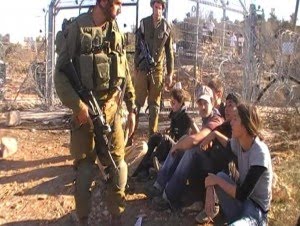
Ayer, sábado 20 de noviembre, a la 1.30 de la tarde en Beit Ummar, al sur de Cisjordania, fueron arrestados por soldados israelíes, un niño palestino de 14 años de nombre Mohammad Awad, dos voluntarios internacionales del (PSP) Proyecto Solidario con Palestina, y tres usraelíes solidarios con la causa palestina. Las detenciones se llevaron a cabo durante una marcha pacífica en contra del asentamiento ilegal de Karmei Tsur construido sobre territorio que pertence a Beit Ummar (Beit Ommar)
Beit Ommar y el adyacente Valle de Saffa, ha sido testigo recientemente de la reiterada represión del ejército israelí. El jueves 18 de noviembre, trece palestinos, israelitas y activistas internacionales, fueron arrestados cuando acompañaban a los agricultores de Saffa a laborar sus tierras, cerca del asentamiento ilegal de Bat Ayn. El mes pasado, los soldados efectuaron redadas, allanamientos y arrestos en la villa durante la noche, tres veces por semana. En ese accionar 35 personas resultaron detenidas. Varias más han corrido la misma suerte en invanciones del mismo tipo durante el presente mes.
La marcha de esta semana comenzó después de la 1 de la tarde. Alrededor de treinta palestinos acompañados por activistas internacionales y de Israel, se dirigieron hacia la alambrada que rodea el asentamiento ilegal de Karmei Tsur.
Unas dos docenas de soldados de Israel y oficiales de la policía de frontera bloquearon el avance de la movilización, por lo que los maniofestantes se sentaron en el suelo, entonaron cánticos en contra de la ocupación y corearon estribillos repudiando la injusticia ante la negación del acceso a los palestinos a sus propias tierras.
Después de una media hora de manifestación pacífica, un pequeño grupo de palestinos se acercó a los soldados y los confrontó, a lo que los soldados respondieron arrojando bombas de estruendo y tratando de arrestar a un miembro del Comité Nacional. Esta persona logró evadirse y al sentirse burlados, los soldados arrestaron a un niño que tenían cerca y cinco activistas más.
Ante esta actitud, otros activistas en solidaridad con los arrestados, hicieron frente a los soldados, por lo que se les arrojaron bombas de gases lacrimógenos y perseguidos en el camino que conduce a la villa.
Karmei Tsur, es un asentamiento ilegal de acuerdo a las leyes y declaraciones internacionales. Es uno de los cinco asentamientos construidos en tierras que pertencen al pueblo palestino de Beit Ommar (Ummar. Las manifestaciones se realizan todos los sábados organizadas por el Comité Nacional en contra del Muro y los Asentamientos de Beit Ommar y el (PSP) Proyecto Solidario con Palestina.

English.-
Beit Ommar, Southern West Bank, 1:30pm: One 14-year-old Palestinian boy named Mohammad Awad, two internationals volunteering with P.S.P., and three Israeli solidarity activists were arrested by Israeli Forces during a peaceful demonstration against Karmei Tsur, an illegal Israeli settlement built on Beit Ommar land.
Beit Ommar and the adjacent Saffa valley have recently witnessed a tide of suppression by Israeli soldiers. Thursday, November 18th, thirteen Palestinian, Israeli, and international activists were arrested accompanying farmers to their land in the Saffa valley, near the illegal Bat Ayn settlement. In the past month, soldiers have raided the village during the night and made arrests three times a week: 35 people were arrested in October, and several have been arrested this month.
The weekly demonstration started just after 1pm as 30 Palestinians, along with many International and Israeli solidarity activists, marched toward the fence surrounding the Karmei Tsur settlement.
Around two dozen Israeli soldiers and border police blocked the path of the demonstrators, who sat on the ground, chanted against the occupation, and made speeches on the injustice of denying Palestinians access to their own land.
After half an hour of peaceful demonstrating, a small group of Palestinian youth moved closer to confront the Israeli soldiers, who responded by firing sound bombs and attempting to arrest a member of the National Committee. As he evaded arrest, a young boy and five other activists were taken in his place.
Activists returned to face the soldiers and stand in solidarity with those arrested. They were then repeatedly shot with tear gas and chased up the road to the village.
Karmei Tsur, an illegal settlement according to international law, is one of five built on land belonging to Beit Ommar villagers. The demonstration is held every Saturday and organized by the National Committee Against the Wall and Settlements in Beit Ommar, and the Palestine Solidarity Project.

viernes, 19 de noviembre de 2010

Continúan bombardeos intermitentes en Gaza-Air strikes continue in Gaza


Español.-
El reportero de la agencia de noticias Ma'an, Jared Malsin, informó que continúan los ataques aèreos de Israel, en diferentes regiones de Gaza.
Los ataques, según nos notificó Malsin, ha tenido lugar en Khan Younis, en el sur de Gaza, dos ataques y, uno más, en Deir Al Balah, zona central de Gaza.
En Khan Younis cuatro personas resultaron con heridas de gravedad y dos en Deir Al Balah.
Un vocero del ejército israelí, anunció que los bombardeos habían sido en tres sitios diferentes. Y explicó que eran en respuesta a otras agresiones sufridas por ellos con morteros y cohetes lanzados desde Gaza Palestina hacia territorios de Israel, hace pocos días.
La calma entre las dos facciones se interrumpió el 3 de noviembre, cuando un cohete de la fuerza aérea israelí, asesinó a Mohammed al-Namnam. El cohete fue lanzado desde un helicóptero sobre Gaza. Otro incidente que detonó las agresiones, ocurrió el 17 de noviembre, cuando dos hermanos, Mohammed e Islam Yassif, fueron muertos por un cohete de manufactura israelí.
Los tres hombres fallecidos, eran sospechosos de Israel de pertencer al grupo de base de Gaza, Jaysh al-Islam (Ejército del Islam).

English.-
Ma'an News Agency's Jared Malsin, has reported, via his Twitter feed that further Israeli air strikes have hit Gaza.
Malsin states that he has been informed that the attacks took place in Khan Younis, in Southern Gaza, which sustained two attacks, and Deir al-Balah, in central Gaza.
In Khan Younis four persons were injured, with two injured in Deir al-Balah. No information on the condition of those injured is known at this time.
The official Israeli Military spokesperson blog has stated that the Israeli Air Force attacked three sites and confirmed direct hits.
The Spokesperson states that the airstrikes come in response to the ongoing exchanges between armed Palestinian factions in Gaza and the Israeli military, claiming that Israel has recieved a total of ten mortars and one Grad rocket fired into its territories over the past few days.
The recent end to calm in the coastal enclave has resulted in two separate incidents of extra-judicial assassination by the Israeli Air Force. On November 3, Mohammed al-Namnam was killed by rocket fire, reported to be from an Israeli helicopter over Gaza, and on November 17, two brothers, Mohammed and Islam Yassif, were killed by a rocket fired from an unmanned Israeli drone.
All three men have been accused of belonging to the Gaza based group, Jaysh al-Islam (Army of Islam).

88 hogares de Silwan serán demolidos-88 homes in Silwan to be demolish


Español.-
Israel ordenó la demolición de alrededor de 88 hogares palestinos en el barrio de Silwan en Jerusalén del Este, según informaron ofiaciales palestinos, fue la advertencia hecha por el despacho judicial israelí de Yehuda Weinstein.
Las demoliciones están programadas a llevarse a cabo en el área de Al Bustan, so pretexto de que las casas palestinas no tenían permiso previo para su construcción. Ahmed al-Rowaidhi, jefe de la Unidad de Jerusalén dependiente de la Presidencia Palestina, manifestó que como resultado de la demolición serán 1500 palestinos los que quedarán sin techo.
El oficial palestino agregó que lo programado por Weintein con esta decisión afecta en total a 20 mil hogares palestinos de Jerusalén Oriental, lo que dejará un tendal de 100 mil palestinos desplazados de Jerusalén y sin hogar, si se continúa con el plan de demoliciones.
Mientras tanto, otras fuentes han anunciado que Israel pone en venta 3 mil unidades nuevas para colonos a partir de los inicios del próximo año. Ya ha sido aprobada la construcción de 1300 en Jerusalén Oriental.

English.-
Israel has ordered demolition of around 88 Palestinian homes in the East Jerusalem neighborhood of Silwan, Palestinian officials warned.
Israeli Attorney, Yehuda Weinstein, handed demolition orders in al-Bustan area claiming that the Arab houses were illegally built. Ahmed al-Rowaidhi, chief of Jerusalem Unit at the Palestinian presidency, said Israel's move will result in 1,500Palestinians being evicted from al-Bustan for the construction of a tourist center.
The Palestinian official added that Weinstein's decision may affect 20,000 homes in East Jerusalem, and some 100,000 Palestinians could be displaced from the area if demolition orders are implemented.
In the meantime, sources recently said that Israel plans to sell 3,000 new settler units in Jerusalem next year after approval for the building of 1,300 units in East Jerusalem.